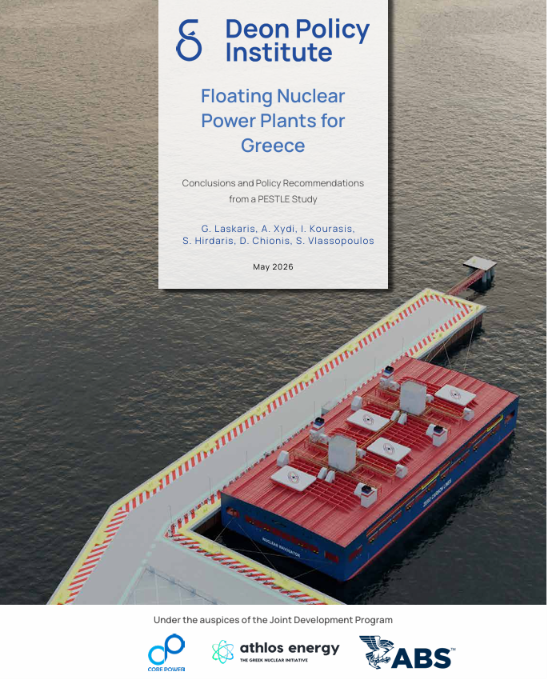
Floating Nuclear Power Plants for Greece
Research Overview
On October 30–31, 2025, a two-day PESTLE workshop was convened in Athens by the American Bureau of Shipping (ABS), CORE POWER UK, and Athlos Energy as part of their Joint Development Program. The workshop brought together 28 senior stakeholders from government, regulatory authorities, energy companies, shipyards, financial institutions, and academia to assess the viability and deployment conditions of Floating Nuclear Power Plants (FNPPs) in Greece.
Deon Policy Institute, which actively participated in the workshop, undertook the documentation and synthesis of its key conclusions. This summary distills the principal findings for stakeholder reference.
It is worth noting that since the completion of the workshop, in March 2026, Greek Prime Minister Kyriakos Mitsotakis announced at the 2nd Nuclear Energy Summit in Paris that Greece will examine the potential role of Small Modular Reactors (SMRs) in its energy mix and establish a dedicated ministerial committee to submit concrete proposals to the government. This marks a significant step forward in Greece’s nuclear journey.
What Are Floating Nuclear Power Plants (FNPPs)?
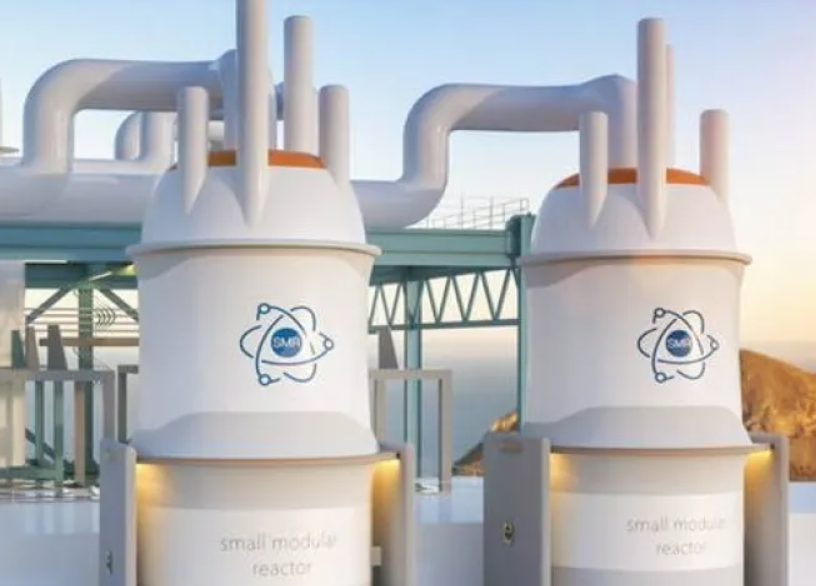
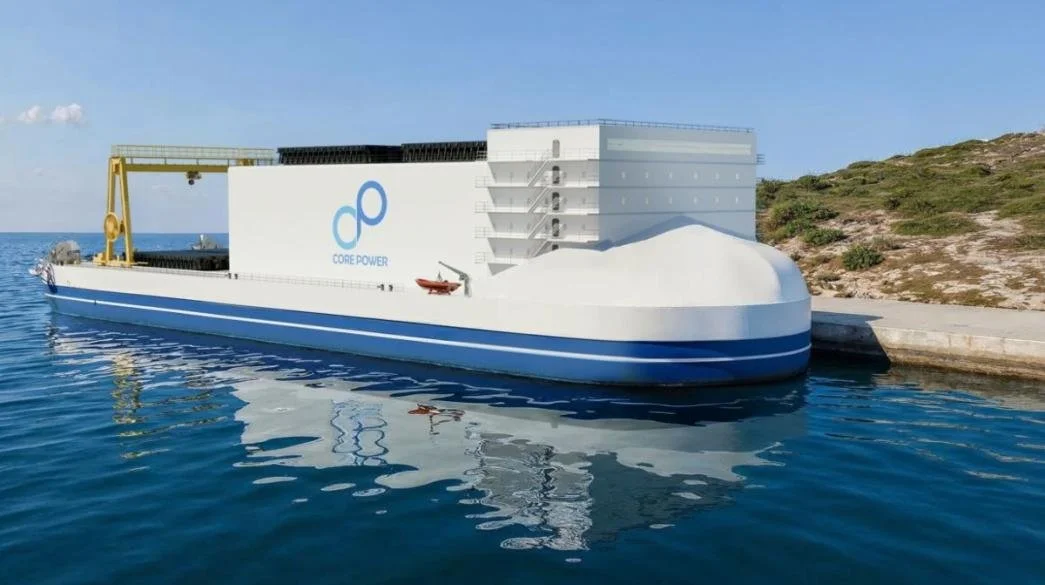
A Floating Nuclear Power Plant is a nuclear installation in which one or more reactors are integrated into a floating platform or vessel, designed to generate electricity, heat, and in some cases, potable water through desalination. They are powered by Small Modular Reactor – smaller capacity reactors designed to be manufactured as standardized units in factory settings and transported to their deployment sites.
The concept is not new—the Russian FNPP Akademik Lomonosov has been in commercial operation since 2019 and the sector shares a common technological and regulatory foundation with decades of naval nuclear propulsion experience in military submarines and surface vessels.
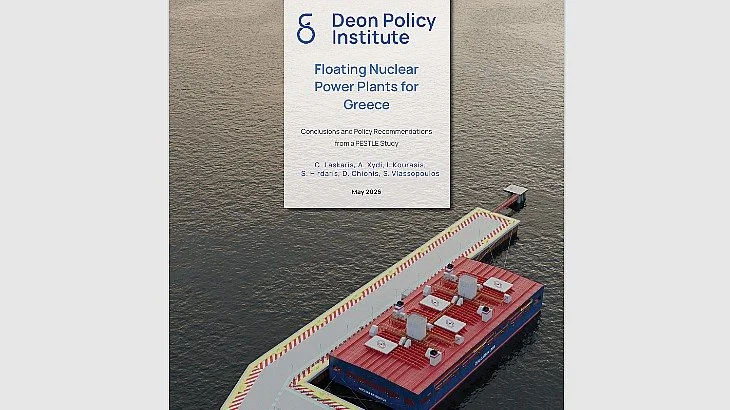
The Report
Interested in learning more about our work in nuclear energy for Greece?
The Case for Greece: Why Floating?
Within the broader SMR framework, there are strong reasons why Greece could prioritize floating applications over land-based solutions—reasons directly linked to the country's geography, industrial base, and institutional specificities:
Spatial and system suitability. Greece's extensive coastline and archipelagic geography favor floating deployment, enabling generation near demand without permanent land use or competition with renewables, agriculture, or housing.
Institutional and investment manageability. Smaller footprints, reduced Emergency Planning Zones, end-of-life removability, and modular deployment with lower capital expenditure make FNPPs more politically feasible and better aligned with Greece's seasonal, high-renewable system.
Operational value. FNPPs can replace oil-fired units on non-interconnected islands, support port electrification and coastal hubs without grid strain, and offer relocation flexibility that limits long-term infrastructure lock-in.
Maritime advantage. As the world's leading maritime power, Greece possesses a unique comparative advantage. FNPPs leverage shipyard capacity and regulatory expertise, with approximately 75% of total value added associated with the Balance of Plant—areas where the Greek maritime-industrial base already possesses relevant capabilities.
PESTLE Analysis
The PESTLE analysis, as detailed in our report, indicates that Greece’s potential deployment of Floating Nuclear Power Plants (FNPPs) is increasingly viable, but remains constrained less by technology than by institutional preparedness and political continuity. Key findings include:
Strong economic incentives driven by high fossil fuel import dependence and growing electricity demand from industry and data centers
Rising, though still divided, public acceptance, alongside persistent concerns about waste, accidents, and health impacts
FNPP technology is considered mature and commercially credible rather than experimental
No major legal or regulatory barriers were identified, provided Greece strengthens international cooperation and regulatory capacity
Environmental advantages—low emissions and limited land use—are significant but remain undercommunicated in public discourse
Next Steps for Greece
The report concludes that Greece’s ability to deploy FNPPs will depend primarily on whether political momentum can be translated into long-term institutional commitment, regulatory preparedness, and broader public acceptance. Participants identified a phased implementation pathway with a potential deployment window between 2035–2040. Immediate priorities include establishing a permanent government coordination mechanism (NEPIO), integrating nuclear energy into national planning, strengthening regulatory and international cooperation, and initiating structured public engagement. Later stages would focus on financing, site and technology selection, licensing, construction, and eventual pilot operation.
White Paper Authors

Nuclear Physicist & President of Deon Policy Institute

Nuclear Engineer, Core Power

Efstathios (Stathis) Vlassopoulos
Co-Founder of Athlos Energy

Manager, Global Ship Systems Center, American Bureau of Shipping

Co-Founder of Athlos Energy

Executive Director of Deon Policy Institute
Related Articles
-
![]()
FNPPs as a New Technological Opportunity for Greece
STARTUPPER MAG - 28 June 2026
-
![]()
SMRs and the Possible Entry of Nuclear Energy into Greece via Maritime Shipping
EnergyMag - 25 May 2026
-
![]()
Floating Nuclear Power Plants 'Realistic' for Greece
World Nuclear News - 28 May 2026
-
![]()
Nuclear Energy in Greece: The Plan for Floating Power Stations
Business Daily - 29 May 2026