

Streamlining Technology Transfer
Proposal Overview
Motivation
Greece has a well-established academic research culture and is, in parallel, building a more robust entrepreneurship ecosystem. While high-quality research is produced across universities and research centers, the institutional mechanisms that systematically connect research activity with market application remain underdeveloped. As a result, technology transfer often depends on fragmented or case-specific arrangements rather than standardized, scalable frameworks. At this stage of the ecosystem’s evolution, there is a clear policy opportunity to strengthen the institutional infrastructure that supports the effective transfer of research outcomes to the market.
Technology Licensing Guidebook
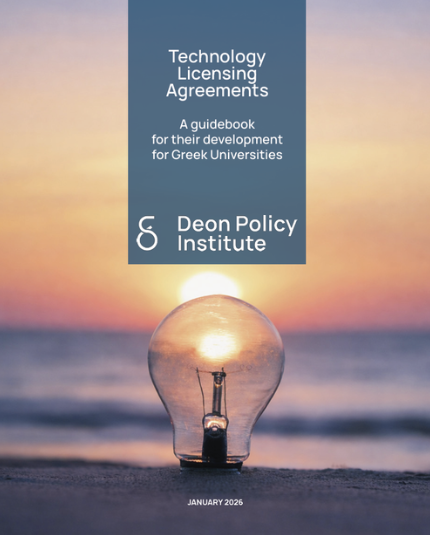
To enable lab to market commercialization at scale in Greece, Deon Policy Institute worked with leading technology transfer experts and practitioners from leading university commercialization systems - like MIT and Harvard - to develop a practical guidebook that would support technology transfer officers in the drafting, negotiating and execution of their agreements.
The guidebook offers a structured, practice-driven analysis of the core components of university technology licensing agreements, focusing on the terms that most directly influence incentives, risk allocation, and the likelihood of successful commercialization:
License rights (scope, exclusivity, field of use, sublicensing): Determine how technologies reach different markets and users, allowing universities to balance focused commercialization with broader dissemination of publicly funded research.
Development and commercialization obligations: Used to translate research into execution by helping licensees set credible development plans, stay accountable to them, and drive technologies toward real commercial outcomes.
Financial terms (upfront fees, royalties, equity, milestones, exit provisions): Structure how value is shared over time, allowing universities to participate in upside while preserving the economic viability and fundability of new ventures.
Reporting, audit, and payment structures: Provide the operational backbone of a license, enabling universities to monitor progress and payments without creating unnecessary administrative burden for companies.
Warranties, liability, indemnification, and insurance: Allocate legal and financial risk in a way that protects public institutions while remaining workable for early-stage companies and commercial partners.
Beyond defining individual terms, the guidebook provides context-specific guidance on how licensing structures vary across use cases—including early-stage startups versus established companies, software-based versus hardware-intensive technologies, and regulated versus non-regulated sectors. This enables Technology Transfer Offices to move beyond template application and exercise informed judgment on how and when different terms should be applied in practice.
Why This Matters
Effective technology transfer is a critical enabler of innovation-led growth, institutional credibility, and the public return on research investment.
Accelerates knowledge transfer: By clarifying and standardizing core licensing practices, the guidebook helps research move more efficiently from the lab to the market, reducing delays and uncertainty in commercialization.
Strengthens institutional capacity: A shared, practical framework supports Technology Transfer Offices in building consistent processes and professional judgment, particularly as TTOs continue to evolve across Greece.
Reduces friction for innovators and investors: Common baselines and clearer expectations make it easier for researchers, students, startups, and industry partners to engage with universities across the country.
Aligns public research with public value: Well-designed licensing terms ensure that publicly funded research is deployed in ways that maximize economic, societal, and technological impact.
Positions Greece within international best practice: Adapting proven approaches from leading global systems enables Greek universities to operate with greater credibility, comparability, and confidence in international collaborations.
The Report
The Impact of our Research
Working with practitioners across the Greek innovation ecosystem—including Technology Transfer Offices, venture capital investors, academic researchers, and IP and technology transfer lawyers—this research was used to develop a practical technology licensing agreement template. The template has now become the nationwide technology transfer template and has been disseminated to all members of the National Network of Technology Transfer Offices (METEX), reaching the all Technology Transfer Offices of public universities and research centers across Greece.
With the support of:

Marina Hatsopoulos
Entrepreneur & Writer

Dimitris Georgakopoulos
Co-founder Helidoni Foundation, Helidoni Group, Outseta and Buildium LLC

Alex Eleftheriadis
Founding Partner at Big Pi Ventures

Acknowledgments

Alan Gordon
Consultant for the Harvard Office of Technology Development

Ayis Antoniou
Visiting Scholar / Advisor & Former Administrative Director, Wyss Institute, Harvard University

Joshua Lev Krieger
Høegh Family Associate Professor of Business Administration in the Entrepreneurial Management Unit, Harvard Business School

Steven Kousouris
Executive Director - Technology Transfer, Johns Hopkins Technology Ventures

Sam T. Liss
Executive Director - Strategic Partnerships, Office of Technology Development, Harvard University

Vinit Nijhawan
Managing Director, MassVentures & former Managing Director, Office of Technology Development, Boston University

Vasiliki Koniakou
Intellectual Property Manager, AUEB Technology Transfer Office

Sofia Tsakiri
Lawyer & Technology Transfer Expert

Stratos Baloutsos
Head of Technology Transfer, Athens University of Economics and Business

Angeliki Karagiannaki
Managing Director, Athens Center for Entrepreneurship and Innovation

Katerina Pramatari
Professor, Department of Management Science and Technology at AUEB & Founding Partner, Uni.Fund

Related Features
Afroditi Xydi’s Keynote Speech at
2nd Annual Conference of the National Network of Technology Transfer Offices (METEX)
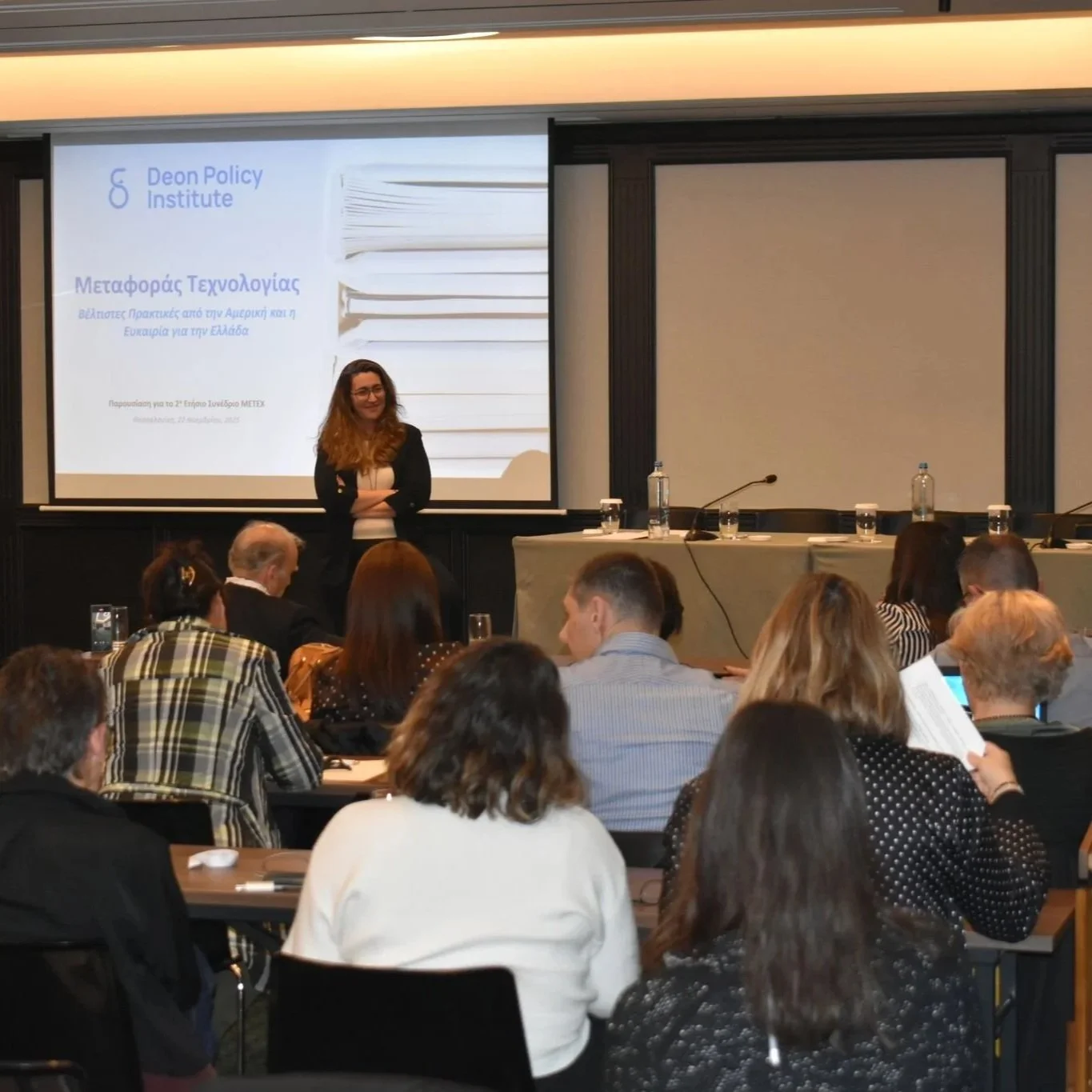
Afroditi Xydi, Executive Director of Deon Policy Institute, delivered a keynote address at the Annual Technology Transfer Conference of the Hellenic Network of Technology Transfer Offices (METEX), focusing on how technology transfer systems operate in the United States. Drawing on practical experience, the session examined U.S. university IP policies, the day-to-day functioning of Technology Transfer Offices, incentive and revenue-sharing structures, core licensing terms, and the role of universities in supporting spin-outs—emphasizing the importance of speed, clarity, and institutional design in successful commercialization.