

Addressing Period Poverty
Research Overview
Period poverty refers to the inability to afford or reliably access period products, and to the consequences that follow: the use of improvised alternatives, the extended use of products beyond safe intervals, absence from school and work, reduced participation in social life, and the associated health risks. The cost is recurrent, non-discretionary and regressive in its incidence, falling disproportionately on low-income households. Its consequences are therefore not confined to household budgets but extend to educational attainment, labour market participation and health outcomes.
The European Union has recognised this as a pan-European challenge, and to address it issued Council Directive (EU) 2022/542 of 5 April 2022. The directive aims to increase the affordability of period products by classifying them among the categories of goods that cover basic needs, allowing member states to apply a reduced rate below 5% or a zero rate to them. Prior to the directive, the lowest rate permissible on these products was 5%. Several member states have since reduced the rate they apply. Greece has not. Period products remain subject to the standard rate of 24%, the rate applied to cosmetics, tobacco and alcohol.
Assessing whether Greece should follow, and what accompanying measures would be required, depends on current national evidence. The most recent measurement prior to this study was conducted by MRB in 2018, which identified the problem for the first time: 20% of mothers reported difficulty affording period products, 18% had foregone other basic necessities at least once in order to purchase them, and 10,000 girls had missed at least one day of school as a result.
Deon Policy Institute partnered with Its Just Period and the WHEN HUB to commission MRB Hellas to update this evidence base. The survey, conducted in December 2025, is nationally representative and comprises a general population sample and a dedicated module of women who menstruate. It examines affordability, coping behaviour, health, stigma and public attitudes towards the available policy options.
In Partnership with:



Supported by:

The Report
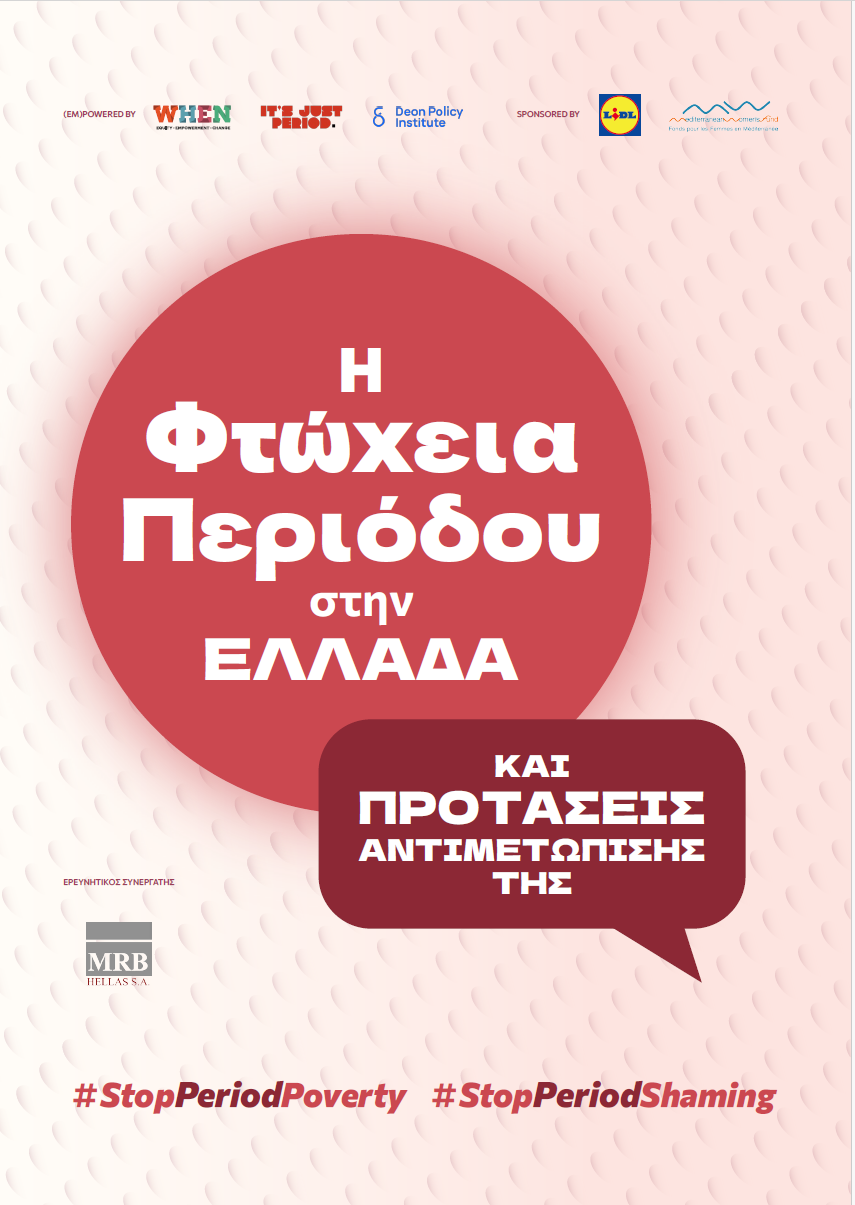
Scope of Work
The project pairs original nationwide research with a policy programme built directly on its findings — evidence first, recommendations second, each proposal traced back to what the data shows and what it would cost the Greek state.
Nationwide representative survey — primary quantitative research conducted with an independent polling institute, measuring the affordability of period products, the functional impact of menstrual pain on daily life, and public attitudes toward menstrual stigma. Each is recorded at national scale in Greece for the first time.
Comparative policy review — how period poverty is addressed across Europe and internationally: VAT treatment, free-provision schemes, menstrual health education in school curricula, and paid menstrual leave, alongside an audit of the programmes currently operating in Greece.
Fiscal assessment — the annual cost to the state of each proposed measure, set against the population it would reach, so that the choice facing policymakers is a budgetary decision with known parameters rather than an open-ended one.
Costed policy recommendations — proposals spanning taxation, direct provision, education and labour law, informed by the survey results, benchmarked against European practice, and written for the ministries that would implement them.
Why This Matters
Establishes a national evidence base — representative national data replaces anecdote and international extrapolation, giving ministries, parliament and civil society a common set of figures to work from.
Makes the fiscal question answerable — costing each measure against the state budget turns "can Greece afford this?" from a rhetorical objection into a number that can be assessed.
Protects participation in education and work — days lost for want of a basic product are days lost from classrooms and workplaces, a direct and avoidable drag on participation.
Aligns Greece with European practice — most of the EU has already moved on VAT for period products; the evidence clarifies what alignment would cost and what it would deliver.
Treats stigma as a policy variable — measuring shame and taboo makes them tractable, so education and public information can be designed and evaluated against a baseline.
White Paper Authors


Chief of Staff, Puberry
Co-founder, It’s Just Period
Executive Director of Deon Policy Institute
Editorial oversight

Co-Founder of WHEN, Head of Research Programs & Strategic Partnerships

Co-Founder of WHEN, Head of Empowerment Programmes and Training Interventions
Related Articles

HEALTH & HUMAN RIGHTS
A Reform that can Happen Tomorrow
Kathimerini - July 13, 2024
by Thodoros Georgakopoulos
Greece should reduce VAT on period products from 24% to at least 13%, a simple and low-cost reform with significant benefits. Period products are essential for women, yet Greece taxes them at the highest rate, unlike many European countries that have significantly lowered their VAT on these items. Reducing VAT on period products would provide financial relief to women, especially those from poorer families, without a substantial fiscal impact. This straightforward policy change would promote gender equity and economic fairness.