
Press Release
Deon’s New Report:
Floating Nuclear Power Plants for Greece
Contact:Theodora Kachrimanidi
Email: info@deonpolicy.org
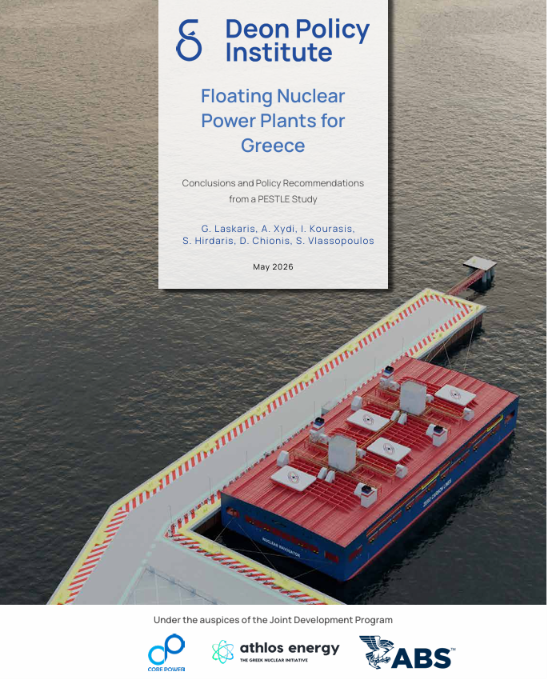
Boston, MA — May 19, 2026 — Deon Policy Institute has published the first-ever report from research examining how Floating Nuclear Power Plants (FNPPs) could be considered within the political, social, economic, policy and regulatory context of a European country, using Greece as a case study, available here.
The policy insights are derived from a research programme conducted by CORE POWER, Athlos Energy and the American Bureau of Shipping, the full results of which are expected to be published later this year.
Greece has historically not deployed nuclear power; however, following the Greek Prime Minister’s announcement that the country will officially explore the role of nuclear energy, a productive discussion has begun to take place in public discourse. The maturation of new technologies, such as Small Modular Reactors (SMRs), which incorporate enhanced safety features, greater operational flexibility, and savings in terms of cost and construction, is making nuclear increasingly relevant as an alternative low-carbon generation technology.
Given Greece’s long maritime heritage, developed port infrastructure and reinvigorated shipbuilding industry, the potential for deploying FNPPs warrants consideration. FNPPs are also compatible with Greece’s geography and energy markets, given the large number of inhabited islands, the increasing need for desalination and the country’s climate goals.
The research provides a structured assessment of the political, economic, social, technological, legal and environmental factors that would shape the potential deployment of FNPPs in a European country such as Greece, based on a PESTLE framework.
The study identifies several key findings:
· Policy, legal and regulatory frameworks in Greece do not yet substantively address nuclear energy or FNPP deployment, reflecting a broader gap in European energy and maritime policy discussions.
· No fundamental barriers to implementation were identified, suggesting that the challenge is not one of feasibility, but of framework development.
· Clearer assessment and regulatory pathways are needed, including coordination across maritime, nuclear and energy authorities.
· Social acceptance of nuclear energy remains low in Greece compared with other countries, even though FNPPs are perceived more positively, implying a need for further education and engagement with both the broader public and key stakeholders.
· There are no major technical barriers to FNPP deployment given the maturity of the technology; however, there is a need for the development of local value chains and workforce capability.
"Construction of nuclear power stations on land is subject to the Iron Law of Megaprojects. It's always behind schedule and always over budget. FNPPs, as complete turnkey power stations built in specialised shipyards to the highest standards, break that law and create the conditions we need to scale the deployment of a safe, reliable electric power supply from nuclear energy. This study aims to advance the conversation about FNPPs within EU policy, using Greece as a practical example.
Nuclear is emerging as the only solution that solves both energy security and greenhouse gas reductions. We're seeing a powerful momentum building for FNPPs, and the role of governments is now to shape existing frameworks to facilitate rapid deployment."

- Mikal Bøe, founder and CEO of CORE POWER
The characteristics of the Greek energy market - high electricity costs, strong dependence on imported fossil fuels, the need for reliable and predictable baseload power, and the obligation to comply with decarbonisation targets - are not unique and are likely to be replicated across other European markets.
The findings suggest that while floating nuclear is not currently embedded within policy frameworks, it could be considered within existing systems, provided that appropriate assessment and regulatory processes are developed.
The publication of the study comes ahead of the Posidonia International Shipping Exhibition 2026, where CORE POWER will convene industry leaders, policymakers and experts to explore the future role of nuclear in maritime applications. A special conference session is organised on 2 June 2026.


“These initial findings shed important light on how FNPPs can be assessed and integrated within existing frameworks, a critical question as the industry moves toward practical deployment. The real challenge before us is integration into policy and regulatory frameworks, and ABS is committed to helping the industry navigate that path.”
- Patrick Ryan, ABS Senior Vice President and Chief Technology Officer

“Over the past year, through close collaboration between ABS, CORE POWER and Athlos Energy, we have examined the interdisciplinary and complex question of how Floating Nuclear Power Plants could apply to the Greek context. As nuclear energy is now entering the Greek public dialogue, this work provides one of the first comprehensive assessments of the challenges, opportunities and risks associated with FNPP technology for Greece’s energy system needs.”
- Dionysios Chionis, Co-Founder of Athlos Energy
“This PESTLE study shows that Floating Nuclear Power Plants are not a distant or purely theoretical option for Greece. No fundamental technical or institutional barriers were identified; the real challenge is building the policy, regulatory, financial and social foundations needed for responsible assessment. For Greece, FNPPs sit at the intersection of energy security, decarbonization, maritime capability and industrial policy.”

- Georgios Laskaris, Nuclear Physicist, President of Deon Policy Institute
About Deon Policy Institute
Founded by a group of Greek academics, entrepreneurs, and professionals, the Deon Policy Institute is a non-partisan think tank that aims to organize and transform the Hellenic Diaspora into a catalyst for the progress of Greece.